Complete Book Summary
Book Overview and Foundation by Doctor Vermeille
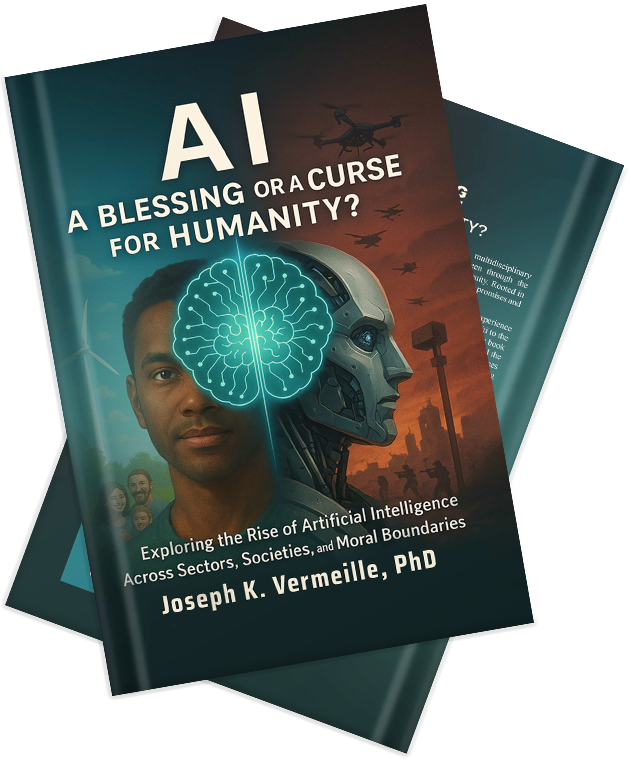
This book presents a multidisciplinary exploration of artificial intelligence’s profound impact on contemporary society, weaving together scholarly research and personal reflection to examine AI’s complex role across ethics, education, governance, labor markets, and social equity. The work critically assesses both the transformative promises and potential perils of AI across diverse technological contexts, from highly developed digital infrastructures to regions with limited technological access.
The preface establishes an urgent tone of both awe and concern regarding AI’s rapid ascent in human affairs. Through personal experiences and observations, the author frames the entire work as both a rigorous inquiry into AI’s implications and a call to collective responsibility, challenging readers to actively consider their role in shaping how the AI era unfolds. This personal dimension adds depth to what might otherwise be a purely academic treatment of these critical issues.
The book’s structure encompasses eight major thematic sections that systematically examine AI’s dual nature across technological, ethical, sectoral, and global governance dimensions. The work concludes with a forward-looking vision for responsible innovation that prioritizes human welfare and social justice in AI development and deployment.
Framing the Central Dilemma
The opening section introduces the fundamental question that drives the entire analysis: whether artificial intelligence represents a blessing or curse for humanity. This exploration delves into the inherent paradoxes of power and responsibility that emerge as AI systems become increasingly capable and ubiquitous. The discussion examines potential futures ranging from technological utopia to dystopian scenarios, emphasizing the critical need for global ethical reflection as artificial intelligence transitions from experimental technology to an omnipresent force in daily life.
The foundational chapter on understanding artificial intelligence provides essential context by clearly defining AI and distinguishing between Narrow AI (systems designed for specific tasks) and the theoretical concept of Artificial General Intelligence. Key technical concepts including machine learning, deep learning, and neural networks are explained in accessible terms, while a historical overview traces AI’s development trajectory and its transformative potential across multiple domains of human activity.
Digital Divides and Philosophical Foundations
A crucial early chapter examines the global digital divide and its implications for AI accessibility and impact. This analysis highlights stark disparities in AI access, digital infrastructure, and technological literacy across different regions and populations. The discussion raises fundamental questions about whether AI will serve as a unifying force that elevates all of humanity or will instead exacerbate existing inequalities and create new forms of digital exclusion.
The philosophical and ethical foundations section explores profound questions about the nature of intelligence itself and the moral challenges inherent in creating and controlling artificial minds. This examination addresses critical issues including algorithmic bias, surveillance capabilities, privacy erosion, and the urgent need for inclusive, transparent, and globally coordinated ethical frameworks. The discussion emphasizes that technical capabilities must be balanced with moral considerations and democratic governance.
Promise and Peril: AI’s Dual Nature
The book thoroughly examines AI’s positive potential, detailing how artificial intelligence can drive economic efficiency, revolutionize healthcare delivery, personalize education, advance environmental sustainability, and augment human creativity. This section emphasizes AI’s remarkable capacity to solve complex global challenges while supporting human flourishing across multiple domains of activity.
However, this optimistic vision is balanced by a comprehensive examination of AI’s risks and potential negative consequences. The analysis outlines major concerns including pervasive surveillance, privacy erosion, large-scale job displacement, increased inequality, systemic bias, misinformation proliferation, and dangerous overreliance on automated systems. The discussion warns that these potential harms could fundamentally damage social cohesion and human agency if not properly addressed through proactive governance and ethical design.
Sector-by-Sector Analysis
The book’s central section provides detailed analysis of AI’s impact across eight critical sectors, examining both benefits and drawbacks in each domain. In healthcare, AI enhances diagnostic accuracy, treatment personalization, and access to medical services, while raising concerns about bias in medical algorithms, patient privacy, and the displacement of healthcare workers. The analysis advocates for hybrid models that combine machine efficiency with essential human empathy and oversight.
In education, AI offers powerful tools for personalizing learning experiences and supporting teachers, but also risks deepening digital divides, compromising student privacy, and shifting power from human educators to algorithmic systems. The agricultural sector benefits from precision farming, yield optimization, and sustainability improvements, though challenges emerge for smallholder farmers regarding data ownership and dependency on proprietary platforms.
The construction industry sees automation transforming planning, safety protocols, and design processes, leading to significant efficiency gains and improved worker safety. However, these advances also bring job displacement and new ethical questions around workplace surveillance and accountability for automated decisions.
Military applications of AI encompass intelligence analysis, autonomous weapons systems, and cyberwarfare capabilities. This domain raises particularly acute ethical concerns about lethal autonomy, accountability for military decisions, and global stability, with strong advocacy for maintaining human oversight and developing international norms for AI weapons.
The finance and accounting sectors benefit from AI-driven trading, fraud detection, and process automation, but face challenges related to transparency, algorithmic bias, and cybersecurity vulnerabilities. The need for explainable and trustworthy AI systems becomes paramount when dealing with financial decisions that affect people’s livelihoods.
Transportation sees revolutionary changes through autonomous vehicles, optimized logistics, and smart infrastructure, promising significant safety improvements and efficiency gains. Yet concerns arise about job losses in transportation industries, liability questions for autonomous systems, and privacy implications of connected vehicles.
Technology and manufacturing sectors experience comprehensive transformation through robotics and smart factory systems, delivering substantial productivity gains while necessitating workforce transitions. This transformation emphasizes the critical importance of reskilling programs and robust cybersecurity measures.
Labor Market Transformation
A dedicated section frames the complex debate surrounding AI’s impact on employment, highlighting the historical shift from physical automation to cognitive task automation. This analysis examines patterns of job displacement and creation, global disparities in AI’s labor impact, and the emergence of entirely new professional roles. The discussion emphasizes that adaptability, equity considerations, and commitment to lifelong learning represent key factors in ensuring a humane transition to an AI-integrated economy.
Global Governance and Ethical Challenges
The book addresses the international race for AI leadership and the currently fragmented approach to AI governance, stressing the urgent need for coordinated ethical and legal frameworks that ensure AI serves the common good rather than narrow interests. This section reviews both national and international regulatory efforts, emphasizing principles of transparency, accountability, fairness, and the critical need for enforceable global standards developed through inclusive policymaking processes.
A focused examination of bridging the digital divide explores global inequities in AI access and technological literacy. The analysis advocates for universal infrastructure development, inclusive education programs, and culturally relevant AI systems designed to close rather than widen technological gaps between different populations and regions.
Practical policy recommendations address sector-specific challenges across healthcare, education, agriculture, military applications, finance, transportation, and manufacturing. These recommendations aim to balance innovation incentives with ethical considerations and equity concerns, providing concrete guidance for policymakers and industry leaders.
Human Stories and Real-World Impact
Personal narratives and case studies illustrate AI’s uneven impact across different technological environments, from high-tech societies to regions with limited digital infrastructure. Comparative analysis examines AI’s effects in countries including the United States, China, Brazil, South Africa, Haiti, and Niger, demonstrating how factors such as access, infrastructure quality, and governance frameworks shape outcomes and either deepen existing divides or create opportunities for technological leapfrogging.
AI Vulnerabilities and Systemic Flaws
A critical examination of AI’s shortcomings addresses systemic problems including hallucinations (AI generating plausible but false information), persistent bias, lack of transparency in decision-making processes, and risks of overreliance on automated systems. This analysis warns of potential dangers to truth, trust, and human agency if these fundamental flaws are not addressed through better design and governance.
Specific attention focuses on AI hallucinations and the need for clear warning labels and user education to help people understand AI limitations. Real-world cases of AI errors and automation bias highlight the necessity for explainable, auditable systems with meaningful human oversight capabilities.
Cautionary case studies from recruitment, criminal justice, medicine, and surveillance demonstrate how AI can amplify existing biases and multiply errors when deployed without adequate safeguards. Hidden risks in AI-generated content include misinformation, plagiarism, deepfakes, and subtle erosion of human creativity and critical thinking skills.
The analysis of AI humanization explores ethical and psychological implications of increasingly human-like artificial intelligence, including risks of misplaced trust, potential for manipulation, and blurred lines of accountability when AI systems become more relatable and persuasive.
Future Directions and Conclusions
The concluding sections synthesize the book’s comprehensive analysis, emphasizing that AI’s ultimate impact on humanity depends fundamentally on how these technologies are designed, governed, and shared across global society. The discussion highlights both the risks of deepening existing divides and unprecedented opportunities for global inclusion and human advancement.
Drawing lessons from science fiction and contemporary trends, the analysis explores concepts like Universal Basic Income and the need for new social contracts that preserve human dignity and promote collective well-being in an AI-dominated economy. The final chapter concludes with a powerful call for empathy, ethical governance, widespread AI literacy, and shared responsibility to ensure AI development aligns with human values and social justice.
The epilogue reflects on AI’s profound ethical stakes, the risks of digital colonialism, and hope for a future where human conscience guides technological development rather than being subordinated to purely technical considerations. A spiritual meditation seeks wisdom, compassion, and justice in AI stewardship, emphasizing the moral dimensions of technological choice.
Supporting Resources
Comprehensive appendices provide practical resources including curated reading lists, comparative analysis of major AI tools with accessibility information, essential terminology definitions, global AI adoption mapping, historical timeline of AI development, documentation of humanoid robot applications, and exploration of self-replicating machine concepts that represent emerging frontiers in automated manufacturing and AI-driven innovation.